
Smart Door Locks
Upgrade your home, store, or office with high-performance smart door locks that streamline your security protocols.
Professional Disclaimer!
⚠️ Professional Installation: Recommended products sold by Nextum involve high-voltage electricity and chemical energy storage. Improper installation may result in fire, injury, or system failure. We strongly recommend consulting with a certified electrician or solar specialist before installation.
🔋 Compatibility Check: Always verify voltage matching (e.g., 48V vs. 12V) before connecting components. Nextum is not responsible for damage caused by mismatched inverters, controllers, or batteries.
We focus on replacing outdated mechanical vulnerabilities with intelligent access control, allowing you to manage multiple entry points across various property types with technical precision and ease.
We offer the next generation of residential security, combining military-grade encryption with the versatility of a 3-in-1 access system: biometric fingerprint scanning, anti-peep touch keypads, and traditional mechanical key overrides. We provide the tools for true independence and security, ensuring your home remains a private fortress while offering the convenience of remote management. Whether you are managing a rental property from afar or securing your family home, our hardware is designed for reliability and technical excellence.
Door Locks FAQ
What is a smart door lock?
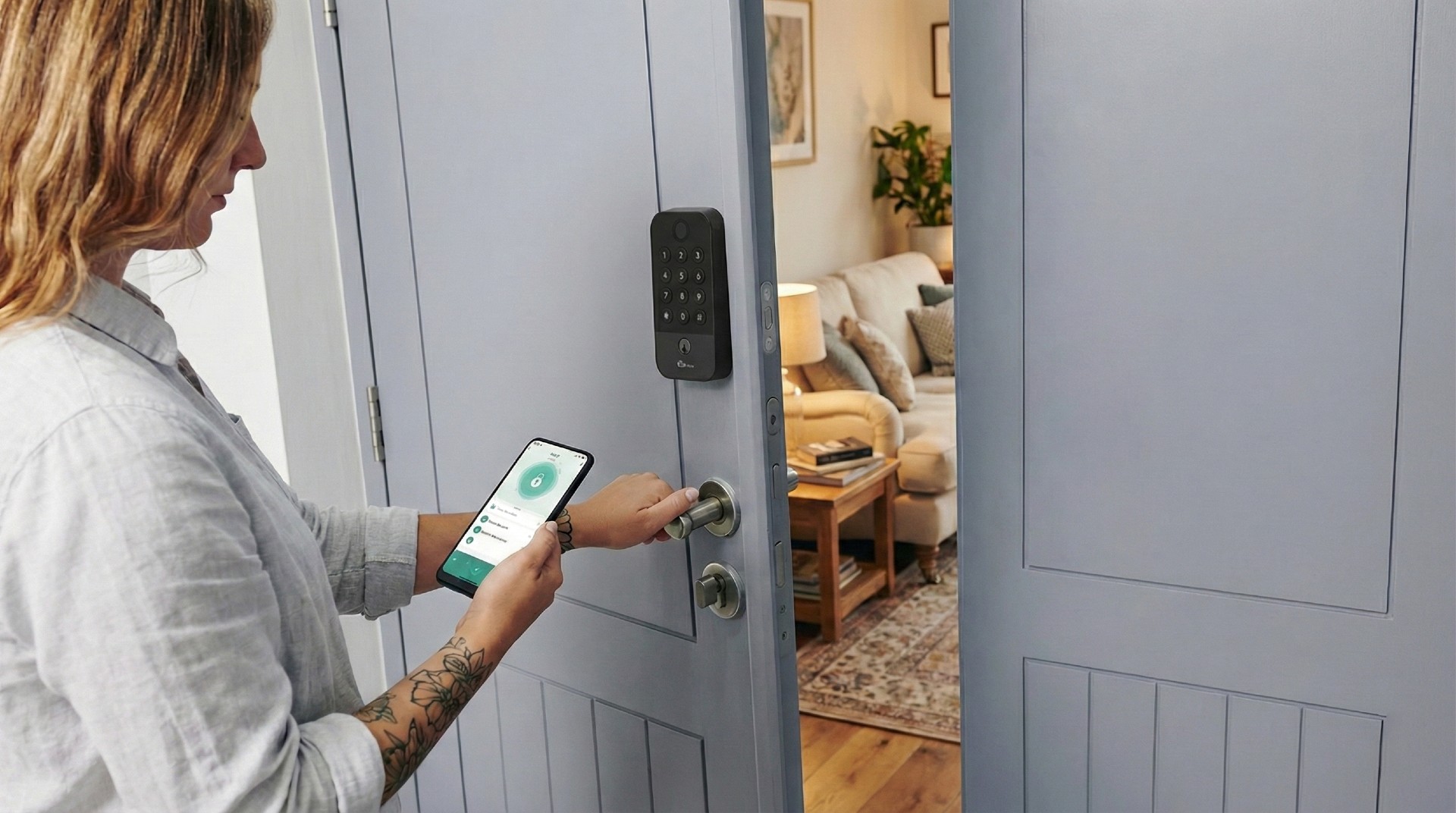
A smart door lock is an advanced electromechanical device designed to perform locking and unlocking operations on a door, providing a sophisticated alternative to traditional hardware. Unlike standard mechanical locks, these units incorporate intelligent electronics to manage access permissions, while maintaining traditional physical interfaces like keypads and key cylinders for maximum reliability.
How does a smart door lock function?
These units function by receiving encrypted instructions from an authorized device—such as a smartphone, biometric scanner, or keypad—using a secure wireless protocol and a cryptographic key. Once the authentication is verified, an internal motorized actuator is triggered to physically move the deadbolt, allowing for keyless entry without compromising the structural integrity of the door.
Can smart door locks work during a power outage?
Yes. Most smart door locks are powered by internal batteries (usually AA or 9V backups) and do not rely on your home's main AC power. Therefore, they remain fully functional even during a grid failure. If the internal batteries die, you can use the physical mechanical key or an external emergency power terminal where you can touch a 9V battery to provide a temporary jump-start.
Are biometric smart door locks secure against hacking?
Our biometric sensors use encrypted data packets to communicate with the internal processor. The fingerprint data is typically stored locally in a "Secure Element" chip rather than in the cloud, significantly reducing the risk of digital theft. Furthermore, the 128-bit AES encryption used for keypad transmissions and wireless signals is the same standard used by financial institutions.
How long do the batteries last in a typical smart door lock?
Battery life depends on the connectivity protocol and frequency of use. Bluetooth and Zigbee models can last between 10 to 12 months, whereas WiFi-connected models, which require more energy to maintain a network heartbeat, typically last 6 to 8 months. Using the physical keypad frequently may slightly increase consumption compared to biometric usage.
Do I need to replace my entire door to install these locks?
No. Most of our hardware is designed to fit standard American door preparations. As long as your door has a standard borehole (usually 2-1/8 inches in diameter), the installation is a straightforward replacement of your existing deadbolt, allowing you to keep your door while upgrading to biometric and keypad security.
Technical foundations of next-gen smart door locks
When we select smart door locks for our inventory, we prioritize the internal architecture and communication protocols. Modern security hardware must do more than just turn a bolt; it must defend against both physical tampering and digital intrusion. Our systems utilize 128-bit and 256-bit AES encryption to ensure that the wireless handshake between your smartphone and the deadbolt remains impenetrable.
Voltage management is equally critical. Most of our high-performance units operate on a 6V DC circuit, typically powered by four or eight AA alkaline or lithium cells. These systems are engineered with ultra-low standby current, allowing for cycle counts exceeding 10,000 operations on a single set of batteries. We recommend using high-capacity Lithium batteries for homes in colder climates to maintain consistent voltage output during winter months. To ensure you never lose access, our locks feature hidden mechanical key cylinders and emergency micro-USB power ports.
Classification and types of smart door locks
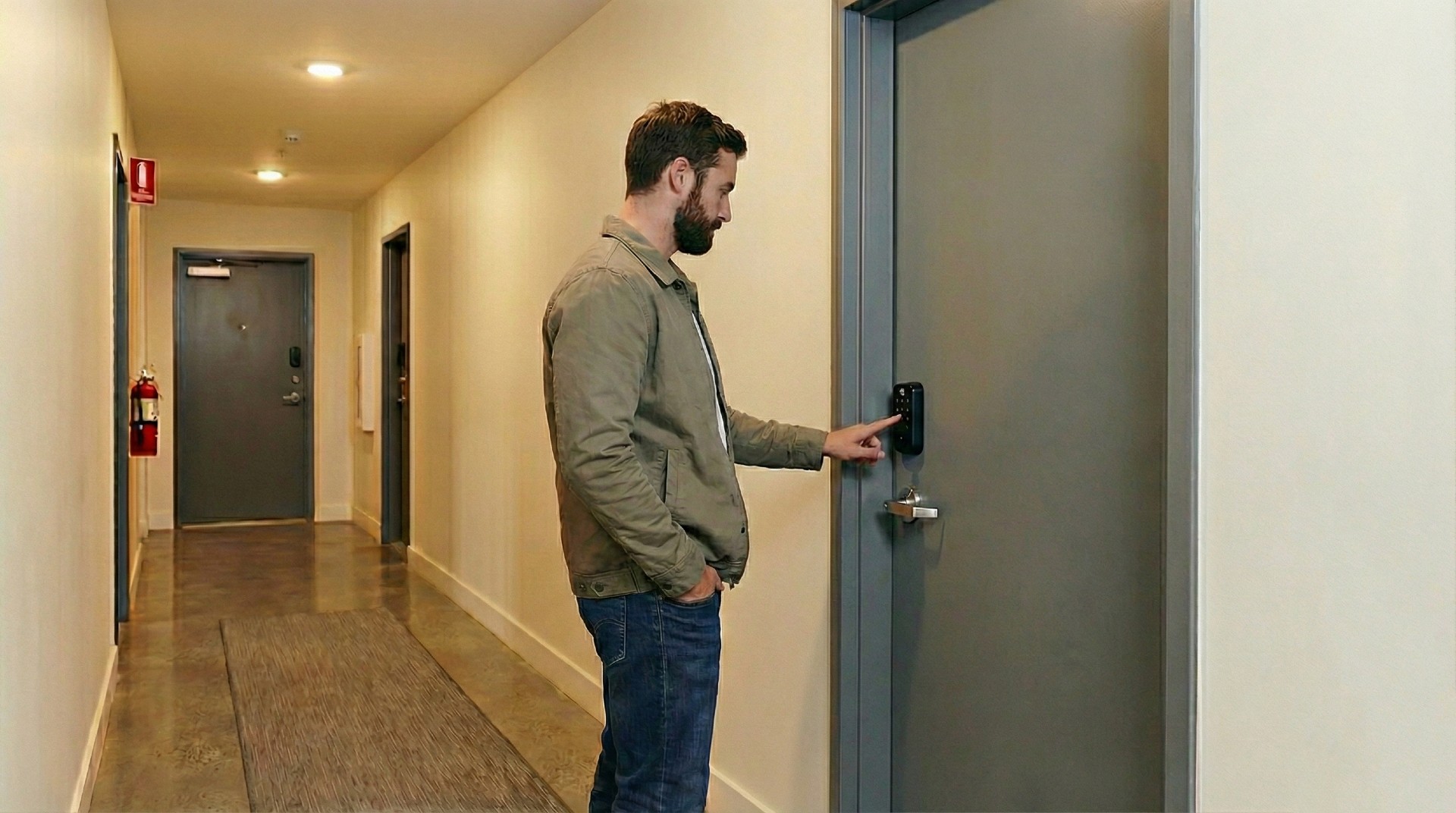
Selecting the right hardware depends on your existing door configuration and your specific security needs. We categorize our units into three primary engineering builds, all featuring triple-access redundancy:
1. Smart deadbolt locks
These are the gold standard for residential security. They replace your existing traditional deadbolt while utilizing the same standard 2-1/8 inch borehole. These units are motorized, meaning the bolt extends and retracts automatically via an internal actuator. They offer the highest physical resistance to forced entry, often rated for Grade 1 or Grade 2 ANSI standards, and include a tactile keypad and a concealed keyhole for manual override.
2. Lever handle and knob smart locks
Ideal for interior rooms, home offices, or side entrances that do not have a separate deadbolt. These units integrate the locking mechanism directly into the handle. Our lever models often feature built-in fingerprint scanners on the thumb-rest area for a natural “grip and unlock” motion, combined with a digital keypad for temporary guest codes and a physical key backup.
3. Retrofit smart locks
For users who wish to keep their existing exterior hardware or are renting, retrofit models attach to the interior side of your current deadbolt. They turn the thumb-turn for you, allowing you to maintain your physical keys while adding WiFi or Zigbee connectivity. Many of our retrofit kits come with an optional external keypad and biometric scanner to provide full keyless functionality without changing your door’s aesthetic.
Advanced biometric and multi-modal access
Nextum Shop specializes in multi-modal entry systems. Our biometric smart door locks utilize capacitive fingerprint sensors rather than older optical versions. Capacitive sensors are significantly more secure as they map the electrical current across the ridges of a finger, making them nearly impossible to spoof with high-resolution images or silicone molds.
Beyond biometrics, our hardware supports rolling-code RFIDs and anti-peep touchscreens. The anti-peep feature allows users to enter random digits before or after their actual PIN code on the keypad, ensuring that onlookers or smudge patterns on the glass do not reveal your private sequence. For those who prefer traditional methods, we include precision-cut mechanical keys that engage high-security cylinders.
Smart home integration and connectivity
Connectivity is the backbone of the modern smart home. We offer smart door locks compatible with Zigbee 3.0, Z-Wave Plus, and dual-band WiFi (2.4GHz/5GHz). For users who prioritize energy independence and off-grid reliability, Zigbee and Z-Wave models are ideal as they consume less power and function through a local hub even if the external internet connection is severed.
If you prefer direct smartphone control without an additional bridge, our WiFi-enabled models offer real-time push notifications and remote logging. This allows you to monitor exactly who entered your home and whether they used a fingerprint, a keypad code, or a physical key, providing a complete audit trail of your property’s security.
Professional technical recommendations
Choosing the right hardware requires an understanding of your existing door preparation. Most American standard doors feature a backset of either 2-3/8 inches or 2-3/4 inches. Our smart door locks typically feature adjustable latches to accommodate both.
We recommend pairing your smart lock with a high-quality gateway if you are using multiple devices. For instance, if you are installing smart door locks on both the front and rear entrances, a dedicated Zigbee hub will reduce the load on your WiFi router and extend the battery life of the locks by utilizing a more efficient mesh network. Always ensure your mechanical backup key is stored in a safe, external location (like a secure vehicle or office) as a final redundancy measure.
So, if you are looking to maximize your home’s “Cool Factor” while significantly upgrading your safety, we suggest looking at models with built-in door sensors. These sensors can detect if a door is slightly ajar and send an immediate alert to your device, preventing the deadbolt from extending into an empty frame.